11/18/2011

Experts differ about state of Saudi investments in Egypt

Fahd bin Juma, an economist, stressed the vulnerability of Saudi investments in Egypt in the current climate, pointing out that these investments are spread over a large number of companies and most are physical assets.
"When any country experiences political turmoil, it reflects negatively on the economy because it reduces the market value of physical assets of any kind," he said.
He said the negative impact on Saudi investments in Egypt will continue until the political and economic situation stabilises, and he expected Saudi investors in Egypt to return to Saudi Arabia.
"With the change in the business environment, Saudi investors are concerned about what would happen in the case of a tax increase," Bin Juma said. "After what happened in Egypt politically and economically, it will take several years before stability returns, and the climate returns to being attractive for investments."
Saudi businesswoman Wedad al-Said said, "The current situation in Egypt worries all investors whether they are from Saudi Arabia or elsewhere. We look forward to the end of this crisis and for life to return to normal with the knowledge that some of the hotels in the capital have begun to operate again. The rate of sales and marketing of Saudi projects [in Egypt] has decreased, and some projects have been halted because of the crisis."

High fuel consumption in the Kingdom of 7% annually for the lack of public transport

Warned a specialist in the oil sector and the energy of the growing proportion of domestic consumption of fuel, which comes at the expense of the outside after the rise in export production capacity of refineries to Saudi Arabia 2.1 million barrels in January 1, 2011, up nearly 7% annually.The economic importance of the specialist counter growing domestic consumption made a strategic decision to establish a network of public transport within and outside the cities and then balance the fuel prices to the point of balance between income and consumption and help to encourage citizens to use transportation and avoid negative effects such as congestion and pollution.He told "Al-Riyadh" Member of the Association of Energy Economics International, Dr. Fahad Bin Juma: the Saudis in the fourth place in the world after America and China and Russia, where consume 2.8 million barrels a day, an annual increase of about 7%, raising the consumption in 2010 increased by 78% compared with 2000.He said I combined to Government support for fuel price cut the price in May 2006 by up to more than 30 percent and diesel by 32% to price ranges liter between 45 and 60 halalas while its price in the Kingdom of Bahrain 1.01 Real, Kuwait 0.85 halalas, Oman 1.16 riyals, and UAE 1.80 Real, and in Qatar 0.83 SR.He said I Gomaa said restructuring of fuel prices and raising prices is not a solution to the problem, useful to have participated in the study raise the prices of gasoline to 120 SR in 1997 to be close to the prices of the Gulf States where they were refused the study, because higher prices are not a solution because it is a pressure on the people with the low income which limits the social well-being and freedom of movement in the absence of public transport specifications commensurate with the level of living of the citizens.And has shown that raising prices to high levels will limit the jam the roads and environmental pollution and waste of economic fortunes, but must be accompanied by the provision of trains between the cities and metro within the city with a bus specification developed, stressing the need for a strategic decision to create a public transportation network within and outside the cities and then raise prices to the extent that balance between income and consumption and encourage citizens to use transportation and avoid negative effects such as congestion and pollution.

Saudis spent millions abroad, while pilgrims boosted the kingdom’s income


The number of Saudi citizens choosing Dubai as a tourist destination increased by 45 percent this year. (File photo)
Fahad bin Juma’a, a Saudi author and economic expert, said that Saudi spending during Eid al-Adha was up by six percent in comparison to the same period last year, totaling 3.33 billion riyals ($89 million).

Salary increases are among the reasons that pushed Saudis to spend more.
Saudi citizens choosing Dubai as a tourist destination increased by 45 percent in comparison to the same period last year, mainly because of the political events unraveling in Syria, Egypt and Lebanon, formerly popular destinations, said bin Juma’a.

Asked if this spending was within the “normal” range, the economist said that income is the determining factor making individuals capable of such travels.
He said that the increased spending on tourism by Saudis did not mean that they got more value out of their travel, citing highly inflated air ticket prices among other expenditures.

“They spent more but got less in comparison to earlier years,” he said.
Dr. Abid al-Abdally, a professor of Islamic economics at Umm al-Qura University in the kingdom, said that the money spent by pilgrims on buying gifts and other memorabilia reached 3.6 billion riyals (approximately $1 billion).

Dr. Abdally said that most pilgrims buy gifts when they visit Saudi Arabia.
“Unfortunately, a big portion of the material [used to manufacture gifts] are imported from outside and are made for Saudi Arabia especially for religious events; this is despite calls to develop the sector locally, which would spur local investment, especially after polls surveying pilgrims suggesting that the pilgrims prefer local manufacturing."

Businessmen seek ministry’s clarity on new zones system


RIYADH: Businessmen here are still unclear about the proposed new zones system introduced by Adel Fakieh, Minister of Labor, to be implemented on June 8. The system is an attempt to deal with foreign recruitment and unemployment in the country.
Saad Al-Mogil, Deputy Chairman of the Chamber of Commerce and Industry in Riyadh, said their meeting with Fakieh failed to answer questions they had about the new system.
He said businessmen are eagerly awaiting the application of the new system so that they can see its merits and demerits and determine its practicality.
Al-Mogil called on the ministry to apply the new system in stages. “Unemployment is a big national problem and can only be solved in reconciling the private and government sectors. It should be understood that the unemployment problem is a common national concern.”
He emphasized that businessmen should cooperate fully with the ministry to solve this critical problem. He said businessmen will not hesitate to approach the minister to inform him about difficulties they face with the new system. “The ministry should not be too demanding and companies and establishments should work in good faith to achieve this national goal.”
He hoped that the plan would help increase training for Saudi jobseekers because this will make it easier for them to be employed.
Dr. Fahd Bin Juma, a prominent Saudi economist, was critical of the system, saying it will never serve the Saudi economy or reduce unemployment.
“The system will result in several companies shutting down and pulling out of the market. It will increase inflation and unemployment. Saudis won’t accept jobs like tea boys, plumbers, carpenters and drivers. Therefore, the industrial and government sector should be developed further because most Saudi jobseekers eye these sectors.”
He said small- and medium- sized businesses are weak and their contribution to Gross National Product is not more than 28 percent.
According to reports, the zones or “Nitaqat” system, will see private companies and establishments classified into three colors – green, yellow and red – according to the number of Saudis they employ.
The green companies will be given a number of advantages, including recruitment of manpower from foreign countries and the transfer of employees in the yellow and red categories without their companies’ consent.
The ministry expects the system to completely wipe out black market in visas where foreigners run businesses using Saudis. Companies in the yellow category that do not fulfill Saudization conditions, should correct their status in order to get the iqamas of their workers renewed.
The iqamas of those foreign workers in red category companies will not be renewed at all, irrespective of the years they have spent in the Kingdom.
The new Nitaqat system allows for the renewal of iqamas without any condition for expatriates who work in companies in the green and excellent category. The new measure would not apply to house servants as their iqamas would be renewed automatically.
– Okaz/Saudi Gazette __

Black market economy growing in Saudi Arabia


Published June 28th, 2011 - 08:28 GMT
The Saudi black market represented 18.7% of Saudi GDP between 2002 and 2007
Economists are requesting the establishment of a regulatory body to evaluate the Saudi Arabian black market economy in order to determine the amount of transactions and the implications the black market has on the activities and practices of the local economy.
In recent years, the Saudi black market has been estimated at 326 billion riyals (US$87 million) and growing.
Professionals argue the black market stems from economic instability in the Kingdom including the development of different economic policies affecting the price index, unemployment rates, unfair competition between citizens and expatriates, a rise in commercial fraud, and monopolies.
One problem is the arrival of new expatriates. Many expatriates practice a phenomenon called "trading trunks". New arrivals bring in trunks of goods on which they do not pay customs duties and sell the goods at very low rates.
Economist Dr. Fahd Bin Juma found that current evidence supports the World Bank's estimate that the Saudi black market will increase in size. He explained that the black market represents 18.7% of GDP between 2002 and 2007, with the percentage rising from 17.5% in 2002 to 20% in 2007, reaching 288.5 billion riyals in 2007.
Dr. Juma noted that the black market distorts the accuracy of economic numbers. 
Source: www.yallafinance.com

The five-year development plans

oor Development Plans
Qenan Al-Ghamdi, Al-Watan, qenan@alwatan.com.sa
 
The economist Dr. Fahd Bin-Juma provided some shocking pieces of information that was published in the Okaz newspaper recently.
Bin-Juma wrote, “The five-year development plans that started in 1970 — 36 years ago — were based on wrong expectations and assumptions. These plans did not take into account well-researched planning strategies. In fact, they were not designed according to accurate statistics predicting the challenges facing the Kingdom today.”
Bin-Juma supported his statements by referring to the latest World Bank report, which noted that the weakness in Saudi economic planning is due to the absence of accurate statistics. The World Bank report emphasized the necessity of having accurate information upon which effective economic strategies could be built.
The economist added, “The Economy and Planning Ministry doesn’t rely on accurate statistical figures. That’s why the last seven five-year development plans were chaotic. It’s only natural considering the circumstances.”
However, a source in the Economy and Planning Ministry responded by saying, “The ministry is doing everything possible, but executing the plans is the responsibility of (other) government bodies and the private sector.”
And we all know what the “government bodies” would say in response to the implementation of the ministry’s projects. There are always obstacles and justifications, and perhaps the projects were set aside precisely because of a lack of accurate statistics and so they archived them and decided to use alternative plans.
Everything is possible. In the absence of information and any viable source of scrutiny, whatever Bin-Juma has mentioned does not make a difference or catch anyone’s attention.
Bin-Juma was not addressing a company that had just recently gone bankrupt or a building that was about to collapse, although there are many, but rather he was talking about something greater. The economist was speaking about an entire country whose development plans have been running in the wrong direction for four decades now.
I don’t want to allude to an assumption that developed countries around the world run systems in which such crimes never occur. But it should be noted that people in positions of responsibility in the Kingdom, those that are appointed as judges and investigators and those that deliver punishments are actually themselves in need of interrogation, judgment and reform.
I felt so much pain writing this and started feeling dizzy, and so decided to put my pen aside thinking that there is no solution. But then I realized that the past is past and no one is able to change that. We’re only concerned with the present and what is happening now. So please stop the eighth five-year development plan. Rather we should revise it and prepare it in a much more systematic and practical way. Fundamentally we should try to save whatever we can. We are undergoing a financial prosperity phase that might never happen again. Our humane, historical and religious responsibilities oblige us to make the best out of our present for our future.

11/17/2011

خلال ندوة على هامش مهرجان الخليج الـ 11 للإذاعة والتلفزيون... أكاديميون وإعلاميون

خلال ندوة على هامش مهرجان الخليج الـ 11 للإذاعة والتلفزيون... أكاديميون وإعلاميون:

الإعلام الاقتصادي غائب عن المستهلك والشفافية شرط لدقة المعلومة

القضيبية - علي الموسوي
أجمع عدد من الأكاديميين والإعلاميين والكتاب الاقتصاديين، على أن الإعلام الاقتصادي العربي، يغيب عن المستهلكين، ولا يقوم بالدور المطلوب تجاههم، وخصوصا في توفير المعلومات الصحيحة والدقيقة، المتعلقة بالسلع الاستهلاكية وسبب ارتفاع أسعارها، فضلا عن غياب التحليل الموضوعي والواضح للمعلومات الاقتصادية التي تبثها الجهات الرسمية والخاصة.
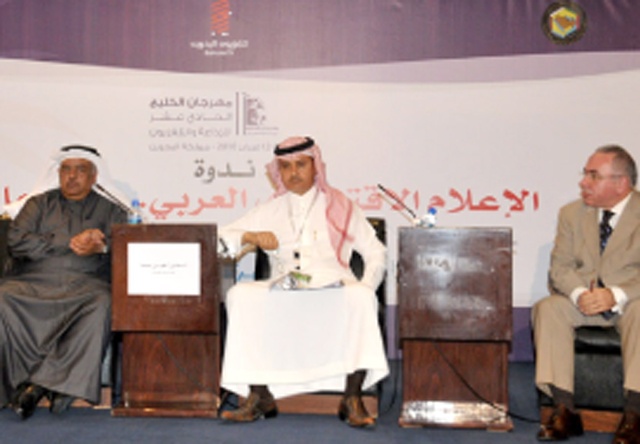
جاء ذلك خلال ندوة أقيمت صباح أمس (الأربعاء) تحت عنوان (الإعلام الاقتصادي العربي... ماله وما عليه)، في قاعة أوال بفندق الخليج، على هامش فعاليات مهرجان الخليج الحادي عشر للإذاعة والتلفزيون، إذ شارك في الندوة الباحث والمحلل الاقتصادي السعودي فهد بن جمعة، ومستشار وزير البترول للشئون الاقتصادية بالمملكة العربية السعودية أحمد الغامدي، والرئيس التنفيذي لشركة دار الوطن للنشر والتوزيع زكريا هجرس. وأدار الندوة كبير مستشاري قناة (سي إن بي سي) العربية، محمد كركوتي.
وأكد الإعلاميون والمشاركون في الندوة على ضرورة أن يحظى المستهلك بجزء من الإعلامي الاقتصادي، وتأدية الوظائف الرئيسية للإعلام، والمتمثلة في المادة التعبوية للجمهور، والتحليل والإرشاد، إضافة إلى نقل الخبر.
فمن جهته، بدأ مقدمة الندوة محمد كركوتي بالقول إن: «الإعلام الاقتصادي يبقى إلى حد كبير ليس معلوما في معاييره العامة، كما أن هناك أسئلة تدور حول موضوع هذا النوع من الإعلام في العالم العربي»، مبينا أنها تصب في مدى وجود «الكوادر المؤهلة لإيصال هذه المعلومات إلى المتلقي، سواء أكان متخصصا أم غير متخصص، كما توجد الكثير من القضايا التي تطرح حاليا حول حجم مسئولية المحطات التلفزيونية والإذاعية تجاه هذا المجال ومسئولية الصحافة والمطبوعات التي تشهد تراجعا من حيث الإقبال عليها».
أما مستشار وزير البترول للشئون الاقتصادية بالمملكة العربية السعودية احمد الغامدي، فاستعرض في ورقته أثر الإعلام الاقتصادي في توجهات الشعوب، وقال إن «وسائل الإعلام الغربية ونظرتها السلبية تجاه البترول في الدول المنتجة والمصدرة، أصبح لها نمط واحد وخط يخرج عن منطق العمل الصحافي، وذلك ببعده عن الصدقية والحيادية والدقة، مستغلة في ذلك المواطن الذي يحفظ المعلومة على ظاهرها من دون تفكير أو تحليل».
وأضاف الغامدي أن «تركيز وسائل الإعلام الغربية انصب على موضوعين أساسيين، هما خطورة الاعتماد على البترول كمصدر أساسي للطاقة، خاصة وان معظم الإنتاجيات منه تأتي من دول الشرق الأوسط، وهي في نظرهم تتميز بعدم الاستقرار السياسي والاجتماعي»، وتابع: «استخدام البترول والمزيد من الاعتماد عليه كان أحد أهم الأسباب لتلوث البيئة والاحتباس الحراري ويجب الحد من استخدامه.
وأشار الغامدي إلى أن: «هذا التركيز أسهم في بداية السبعينيات في تكوين الفكر المعادي للدول المنتجة، وخاصة دول الشرق الأوسط، حين تغلغل في مناهج الدراسة والبحوث العلمية، والمواقف السياسية واستراتيجيات الطاقة المستقبلية والتركيز على الحد من الاعتماد على بترول هذه الدول».
أما الباحث والمحلل الاقتصادي فهد بن جمعة، فشدد على ضرورة وجود الشفافية في إيصال المعلومات الاقتصادية للمستهلكين، وأن تكون هناك مصادر للأرقام التي تنشر في الصحافة، متحفظا على عبارة «مصدر مسئول فضل عدم ذكر اسمه». واعتبر بن جمعة أن رفض المسئول لذكره اسمه، يعتبر مكيدة لتوريط الصحافي، مبينا أن شفافية المعلومة الاقتصادية غائبة عن الإعلام العربي.
وتساءل بتعجب: «كيف يمكن معرفة سبب ارتفاع الأسعار، وما إذا كان السبب في احتكار السلعة أو ارتفاع كلفة إنتاجها، ومن ثم لماذا نتقصى المعلومات من مصادر خارجية، ولا نتقصاها من المصادر الداخلية»، مبينا أن ذلك سببه: «عدم نشر المعلومات في الإعلام الداخلي، وغياب المعلومة الواضحة».
وأكد بن جمعة في ورقة عن «تأثير شفافية المعلومات على مصداقية الإعلام الاقتصادي العربي» أهمية قيام الحكومات العربية بالإفصاح عن المعلومات الاقتصادية بكل شفافية لوسائل الإعلام المختلفة، حتى تصبح الصحافة مسئولة عن صدقية نقل تلك المعلومات، وذلك بمفهوم الشفافية التي تحدد الكيفية التي يتم فيها تقديم المعلومات إلى الجمهور بكل مسئولية، وضمن المعايير التي ترفع من مستوى الشفافية.
واعتبر بن جمعة أن حجب المعلومات الاقتصادية يؤدي إلى فساد مالي أو إداري، وخصوصا إذا لم تنشر بعض الأخبار التي تتعارض مع مصالح الوسيلة الإعلامية.
إلى ذلك، أشار الرئيس التنفيذي لشركة دار الوطن للصحافة والنشر زكريا هجرس، إلى أهمية «تفسير المعلومة إلى متلقي المادة الإعلامية، وسعي الوسائل الإعلامية نحو البحث عن المعلومات الصحيحة، التي تخدم المجتمع، بالإضافة إلى أهمية إيصال الأرقام الصحيحة إلى الجمهور والمستهلك، عبر وسائل الإعلام المختلفة» مؤكدا كذلك على ضرورة «تعاون جميع الجهات في الإفصاح عن المعلومات التي تجنب الصحافيين في الوقوع في أخطاء تضر جميع افراد المجتمعات.

حرب الطاقة.. ركود تضخمي عالمي

الثلاثاء 5 شوال 1447هـ - 24 مارس 2026 م المقال الرياض د. فهد محمد بن جمعة يتجه الصراع المتصاعد في الشرق الأوسط إلى مرحلة أكثر خطورة مع انتقا...